Territorial Council: a heated debate right from the start of the session
Please note that the debates cited in this article took place before the Executive Council was reconstituted and the new vice-presidencies were assigned.
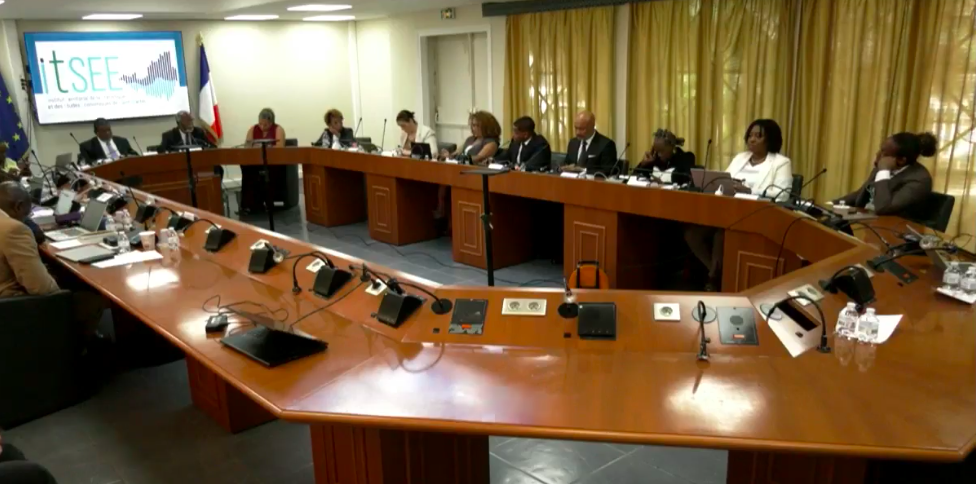
“Dictatorship,” “the pot calling the kettle black,” “she’s a farmer,” “a knife to the throat.” These remarks flew thick and fast on Friday during the Territorial Council’s plenary session—even before the first item on the agenda had been discussed. The reason? President Louis Mussington’s refusal to add to the agenda items proposed by opposition members. A look back at a heated debate.
To understand what happened, it’s important to know that a territorial council’s agenda is approved by the executive council and that the agenda items are signed off on by the president of the territorial authority. On October 23, opposition council members asked the president to convene the territorial council on November 13 and to include four items on the agenda. However, they discovered that their request had not been granted. They explained their actions in a press release.
On Friday, November 13, the territorial council convened. As usual, the president reviewed the agenda items for adoption by the elected officials as required by law but requested amendments to remove certain items. The elected officials from the new opposition then asked to speak, addressed the refusal they had received, and suggested adding their deliberations “on the spot.”
“But we do it all the time!”
“The territorial council’s rules of procedure do not allow for the addition of agenda items on the very day of the meeting,” replied Third Vice President Michel Petit. This statement prompted a strong reaction from Angeline Laurence, Daniel Gibbs, and Philippe Philidor, among others. “But we do it all the time!” Angeline Laurence exclaims. Indeed, on several occasions since the start of the term, Louis Mussington has asked his colleagues to vote on adding items to the agenda at the start of the session, particularly decisions regarding the budget or the financing of Air Antilles.
“We cannot legally add additional items to the agenda on the day of the session,” Michel Petit repeats. “What has been done [in the past] is a matter of leniency,” he concedes. “What is good? What is good for the goose is good for the gander,” comments Angeline Laurence in English. “I see, she’s a farmer’s wife,” replies Michel Petit, prompting a few laughs.
However, the debate continued until Daniel Gibbs returned a few minutes later to address this exchange: Michel Petit “made a remark, and I demand that he apologize. He called Angeline Laurence a farmer’s wife.” “I didn’t know that ‘farmer’ was an [insult]. There was nothing mean about it. (…) She comes from a family of farmers. There’s nothing offensiving or insulting about it,” the vice president explained.
Alain Richardson, as first vice president, then tried to calm things down by explaining that Angeline Laurence had used an expression with agricultural references, which had prompted his colleague’s comment; he nevertheless suggested that his colleague apologize. “No, I won’t apologize,” Michel Petit insisted. He did so only after Angeline Laurence confided that she had been “hurt” and considered his remarks “truly offensive.”
“That’s like the pot calling the kettle black. (…) It’s a dictatorship.”
Back to the debate. Although the third vice president believes the agenda cannot be changed, the rules of procedure and the organic law specify that certain items may be added on the same day “under exceptional circumstances.”
In turn, Louis Mussington spoke on the matter: “You can understand that, as president, I cannot [add the opposition’s items] overnight. Yes, we will add them, but these are issues that deserve careful consideration and review by our committees. And I will take the time necessary [to examine them] because there are consequences, especially since you are asking me to revisit a decision made a few weeks ago.” In this case, the decision regarding the acquisition of the Beauperthuy parcels by the public land agency Terres Caraïbes on behalf of the COM. “It is up to the president to decide when these items will be examined,” insists Louis Mussington.
This remark prompts a response from Philippe Philidor: “You are not the judge of the appropriateness of these deliberations. We are all elected officials, and we all have a stake in this legislative initiative. What ultimately settles the democratic debate is the vote.” In other words, he is asking the elected officials to vote for or against adding these four items to the agenda.
Back to the debate. Although the third vice president believes that the agenda cannot be amended, the rules of procedure and the organic law specify that certain items may be added on the same day “under exceptional circumstances.”
Louis Mussington then spoke on the matter: “You can understand that, as president, I cannot [add the opposition’s items] overnight. Yes, we will add them, but these are items that deserve careful consideration and review by our councils. And I will take the necessary time [to review them] because there are consequences, especially since you are asking me to revisit a decision made a few weeks ago.” In this case, the decision concerns the acquisition of the Beauperthuy parcels by the public land agency Terres Caraïbes on behalf of the COM. “It is up to the president to decide when these points will be examined,” insists Louis Mussington.
This remark prompts a response from Philippe Philidor: “You are not the judge of the appropriateness of these deliberations. We are all elected officials, and we all share in this legislative initiative. What ultimately settles the democratic debate is the vote.” In other words, he is asking the elected officials to vote for or against adding these four items to the agenda.
But Louis Mussington stands his ground: “I’ll decide when, but it won’t happen today—it’s as simple as that.” “You’re denying elected officials a right, even though you yourselves are asking us to add items to the agenda at the last minute. It’s like the pot calling the kettle black. (…) This is a dictatorship,” comments Daniel Gibbs.
“Putting a knife to the president’s throat”
Alain Richardson also spoke out: “The president never said that these items would never be considered. There is no obligation to do so [now], and no one can put a knife to the president’s throat to force deliberations onto today’s agenda.”
To make it clear, the 12 “opportunity” representatives voted against amending the agenda as requested by Louis Mussington. However, only one item was reviewed and discussed: the replacement of Daniel Gibbs on the Executive Council, which ultimately led to the complete renewal of the Council. Due to disagreements between his team and the opposition on certain issues arising from the new composition of the Executive Council, Louis Mussington adjourned the session until Monday at 9 a.m.